Start with a rule of thumb and a photo count
The Department of Energy's roof repair brief repeats a trade rule from the Journal of Light Construction Field Guide: when the patches that need work add up to more than a tenth of the roof surface, a new roof is the better route. The rule only works if someone counts.
From the yard, photograph each slope and mark the trouble spots on the pictures: lifted tabs, bare patches, a stain line at an edge. Ten or twelve marks scattered over one slope is a different story from three marks near a vent. Hand the marked photos to the roofer so the count is on paper.
Count the layers at an edge
The Asphalt Roofing Manufacturers Association says most building codes stop at two roof coverings on a building, and that a roof with two layers already on it needs a tear-off. A single layer that lies flat over a sound deck can take a re-cover.
It also says most shingle manufacturers do not recommend new shingles over existing laminated ones, and that impact ratings may change when shingles go over shingles. At a rake edge or under a vent, a roofer can show how many layers are up there. Ask to see it.
Read the deck, not only the shingles
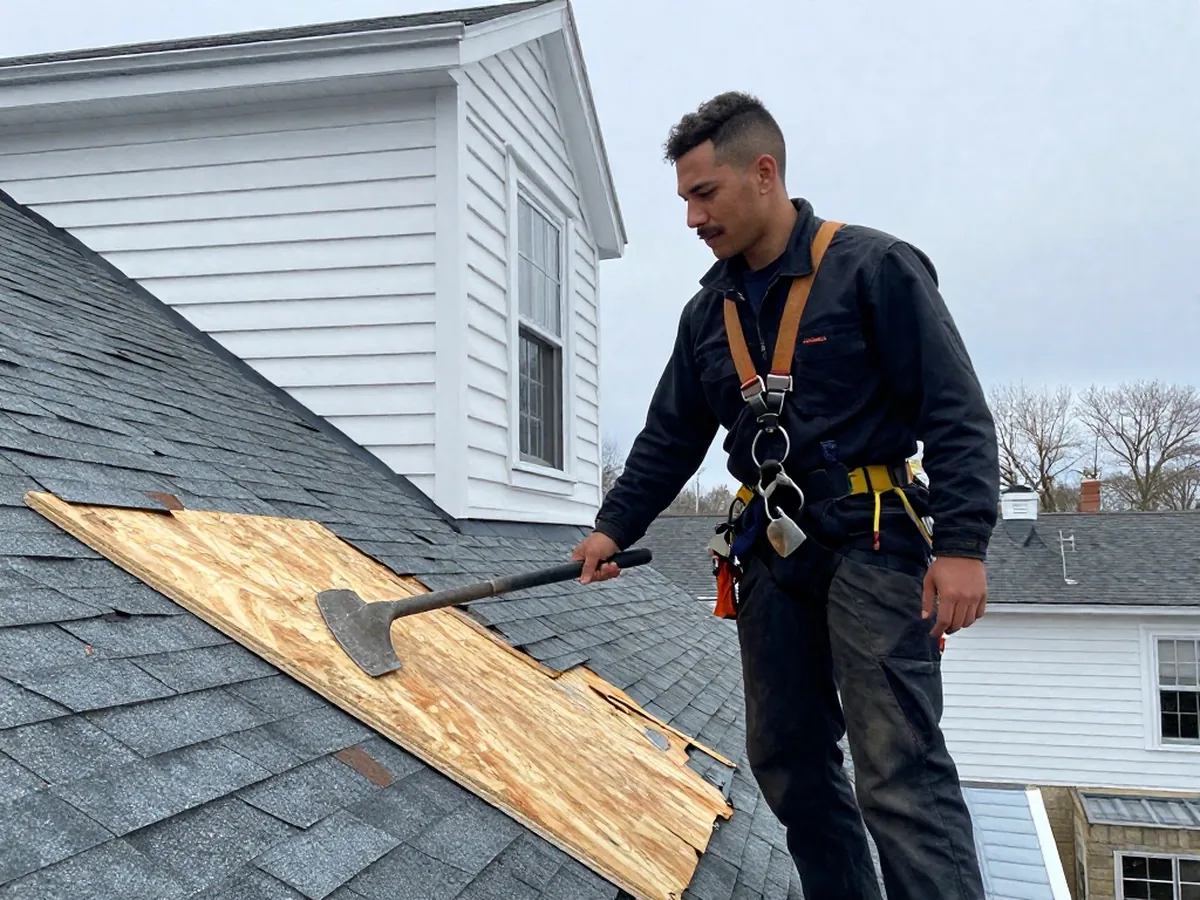
ARMA lists the reasons for a tear-off: sagging along the ridge or the truss lines, rotted or warped deck boards, gaps wider than a quarter inch between boards, and shingles so uneven the new roof cannot lie flat. Damaged boards are replaced before new shingles go on.
If the roof does not look straight or feel solid, ARMA points to a structural engineer. A re-cover hides the deck from view, which is why the question 'what can you see of the boards?' belongs in every quote.
What wet insulation tells you
A stain on the ceiling is a clue about the attic. The Department of Energy brief says soaked insulation is to be removed before the ceiling can dry, that wood needs a moisture content under 20 percent before it is covered, and that drywall touched only by clean rainwater can remain provided it does not sag or mildew.
Those points matter to the patch-or-replace decision because a roof that repeatedly soaks the attic costs more than the shingles. Ask the roofer what the attic side looked like, and ask for photos.
Ask about vents, the eave and the ice
ARMA suggests checking attic ventilation during any reroofing. The Department of Energy brief prefers baffled ridge vents and off-ridge vents, saying unbaffled vents tend to let wind-driven moisture into the attic. The Building America guide on ice dams adds a 2-inch air space between insulation and roof sheathing, with air sealing at the ceiling plane.
New Jersey's Bulletin 07-3 asks for an ice dam membrane only where January averages 25 degrees or colder, and it names Sussex County. Newark's January average of 32.8 degrees puts Rahway outside that, so on a Rahway roof the membrane is a choice to discuss, not a rule.
Put it on paper before the first shingle moves
New Jersey's contract rule says a home improvement contract over $500, and any change to it, has to be in writing and signed by every party. Look in it for the seller's full legal name and address, the work described, the principal materials, a total price and start and finish dates. A consumer affairs checklist adds a right to cancel, which lasts until midnight on the third business day.
Under the state's rules, a roof replacement counts as ordinary maintenance for a detached dwelling of one or two units, though that is not a waiver from code compliance. The hiring checks page has the full list, and the building office for each town.
The decision, one question at a time
- Does work need doing on more than a tenth of the roof?Lean toward replacement and ask for a replacement quote beside the repair quote.
- Two layers of shingles already on the deck?A tear-off is needed, so price a tear-off.
- One flat layer on a sound deck, no sag, no soft boards?A re-cover is possible; ask what the roofer can see of the deck.
- Rotted or warped boards, or gaps wider than a quarter inch?Expect board replacement before shingles, and ask for the count.
- Wet insulation or a stain that keeps coming back?Ask for photos of the attic side before choosing.
- Roof not straight, or the ridge dips?Ask for a structural engineer's look before any roofing.
- None of the above, and one small spot?A patch is reasonable; photograph it and watch the next two rains.
Still unsure which way your roof points?
Bring the marked photos, the layer count and the date of the last repair, then talk it over. Roof replacement and roof leak repair cover the two outcomes. Call (732) 487-3991 and describe what you found.